


RingCentral
Unified communications built for modern business


For decades, contact centres were measured primarily on operational efficiency.
Metrics such as Average Handle Time (AHT), Calls Per Hour, and Service Level were designed to help organisations manage costs, maximise agent productivity, and process high volumes of customer enquiries.
While these metrics remain important, they no longer tell the full story. Today's customers expect faster, easier, and more personalised experiences across multiple channels.
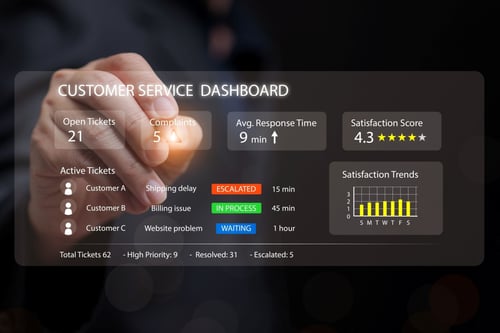
The traditional metrics and benchmarks shown in this section remain foundational for operational management and continue to play an important role in measuring operational performance and ensuring customers can access support when they need it.
Measures such as service levels, speed to answer, abandonment rates, average handling time, occupancy and adherence provide valuable visibility into workforce utilisation, efficiency and service delivery.
When viewed together, these metrics help organisations understand how effectively their contact centre is operating, maintain service consistency and ensure resources are aligned to customer demand.

Measures the total time spent handling an interaction, including talk time, hold time, and after-call work.
Why it matters:
Workforce planning
Operational efficiency
Cost management
Typical benchmark:
Around 6 minutes across many contact centre environments, although this varies significantly by industry.
Measures the percentage of calls answered within a target timeframe.
Traditional benchmark:
80% of calls answered within 20 seconds (the well-known "80/20" standard).
Measures how quickly customers reach an agent.
Typical benchmark:
Approximately 28 seconds across many contact centre environments.
Measures the percentage of issues resolved without requiring a follow-up interaction.
Typical benchmark:
70-75% is generally considered a strong performance level.
World-class contact centres often exceed 80%.

The evolution of contact centre metrics reflects a fundamental change in customer expectations. Customers today want:
They care far less about how quickly an agent answers the phone than whether their issue is resolved quickly and easily.
This is why modern contact centres are increasingly balancing operational metrics with customer outcome metrics. Success is no longer measured solely by speed and efficiency, but by the ability to deliver effortless, connected, and valuable customer experiences.
Modern contact centres focus on outcomes, not just activity.
By combining the traditional metrics with AI-powered analytics, customer sentiment, quality insights, and operational intelligence, organisations can gain a complete view of the customer experience in real time. These insights help leaders understand customer needs, identify friction points, improve service quality, and measure the impact of every interaction on customer loyalty and business performance.
Rather than viewing metrics in isolation, modern contact centres use connected insights to make faster decisions, deliver more personalised experiences, and continuously optimise both customer and employee outcomes.

Measures a customer's satisfaction immediately following an interaction.
Benchmark: For many industries, strong CSAT performance typically sits above 80%.

Measures how easy customers found it to resolve their issue.
Research increasingly shows that reducing effort is one of the strongest drivers of customer loyalty. Questions organisations ask include:
This metric has become increasingly important as digital and self-service journeys expand.

Measures customer loyalty and willingness to recommend an organisation.
Unlike CSAT, which measures a single interaction, NPS evaluates the broader customer relationship.
Why it matters:
Benchmark:

Measures how many customer enquiries are resolved through self-service channels without requiring agent assistance.
As customer preferences shift toward digital engagement, this metric has become increasingly valuable.
Customers increasingly expect:
In fact, research indicates that 73% of customers now prefer digital engagement channels over phone interactions when seeking services.

Leading organisations are beginning to measure outcomes across the entire customer journey rather than individual contacts. Examples include:
Resolution across channels
Time-to-resolution
Customer effort across journeys
Repeat contact rates
Customer retention
These measures provide a more complete view of the customer experience than traditional interaction-based KPIs.